

Not every trip fits neatly into "just call a rideshare" or "book a flight." Sydney to Newcastle, Melbourne to Geelong, Perth to the Pilbara these are too far for a normal city rideshare trip and often too short to justify the hassle of an airport, yet train and coach timetables don't always line up with when you actually need to travel. This is the gap intercity rideshare is built for.
What Is Long-Distance Rideshare with Snap Ride?
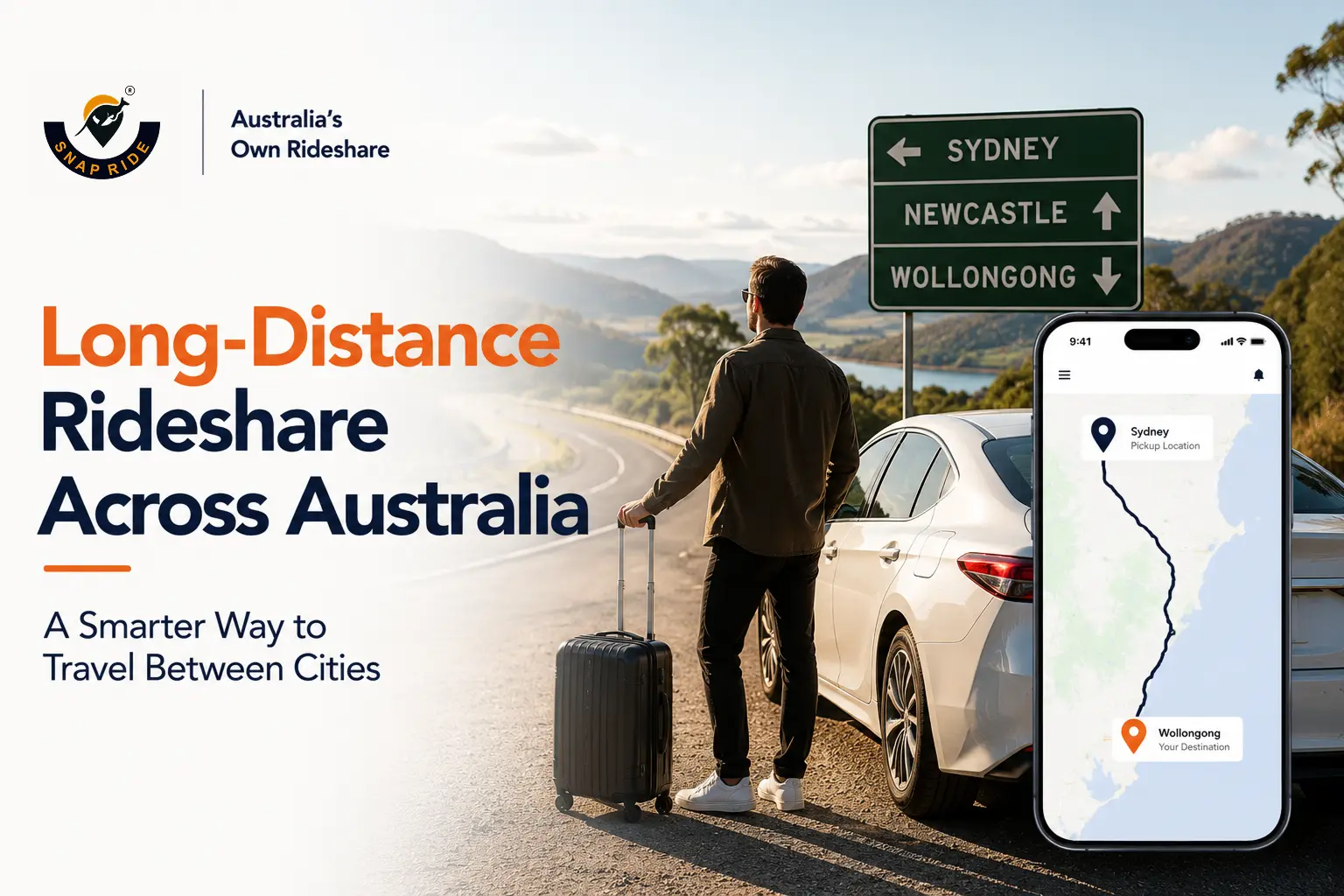
Snap Ride supports city-to-city trips within the same state, think Sydney to Wollongong, Melbourne to Ballarat, or Perth out to regional Western Australian centres like Karratha and Port Hedland. This is different from interstate travel: Snap Ride isn't built for a Sydney-to-Melbourne style crossing between states, and flights, trains, or interstate coach services remain the better option for that kind of distance.
Within a state, though, it fills a real gap, a direct, door-to-door option for the kind of trip that's too long for a local rideshare but doesn't need a full travel booking process.
Why Choose Long-Distance Rideshare Over Other Travel Options?
- Door-to-door, no timetable: Trains and coaches run on fixed schedules; a rideshare leaves when you're ready to leave.
- No transfers or station waits: One trip, one vehicle, straight to your actual destination rather than a station some distance from where you need to be.
- Fixed fare shown upfront: Snap Ride displays the fare for longer routes before you confirm, so there's no surprise adjustment mid-trip the way a metered fare or a demand-based platform might apply.
- Practical for groups: Splitting one intercity trip across several people can work out more efficiently than everyone booking separate transport, particularly with a larger vehicle option.
Popular Long-Distance Rideshare Routes Across Australia
Some routes come up again and again for exactly the reasons above: no convenient train timetable, luggage-heavy travel, or a trip better made door-to-door than self-driven:
- Sydney to Newcastle or Wollongong: a common trip for work, family visits, or events, where train services don't always land close enough to the actual destination.
- Melbourne to Geelong or Ballarat: regional day trips or weekend travel where driving yourself means either a long return trip the same day or leaving a car behind.
- Adelaide to regional South Australian towns: useful for travellers heading out to wine regions or family visits without the hassle of arranging a hire car for a single trip.
The pattern across all of these: same-state, too far for a normal local trip, and better suited to a direct door-to-door option than juggling a timetable or driving there yourself.
Who Benefits Most from Long-Distance Rideshare?
Travellers with Luggage
Anyone lugging a suitcase, sports gear, musical instruments, or work equipment gets a real advantage from door-to-door pickup no hauling bags across a station platform, up stairs, or between a train and a taxi rank at the other end.
Business Travellers
A private vehicle for the whole trip means your own space, your own pace, and no shared carriage, no strangers, no standing room only during a busy period.
Groups Travelling Together
Families, small teams, or friends heading to the same regional town can share one vehicle instead of coordinating separate train tickets or coach seats.
Early Morning or Late-Night Travellers
Early starts, late finishes, or an oddly timed trip that falls between train services all suit an on-demand option better than a fixed timetable.
Anyone Who Wants a More Comfortable Journey
No changeovers, no navigating a station, no dragging bags between platforms; you get in once and get out at your actual destination.
Why Choose a Rideshare Instead of Driving Yourself?
Driving is the obvious alternative for an intercity trip, and for some routes it's genuinely the right call. But it comes with real tradeoffs a rideshare removes entirely:
|
Feature |
Snap Ride |
Train |
Coach |
Driving Yourself |
|
Door-to-door travel |
✓ |
✗ |
✗ |
✓ |
|
Fixed upfront fare |
✓ |
✓ |
✓ |
✗ (fuel, tolls, parking) |
|
No transfers |
✓ |
✗ |
✗ |
✓ |
|
Travel on your schedule. |
✓ |
✗ |
✗ |
✓ |
|
Suitable for groups |
✓ |
Limited |
Limited |
✓ |
|
No driving fatigue |
✓ |
✓ |
✓ |
✗ |
- You arrive tired: A few hours behind the wheel before a work meeting, an event, or a flight connection isn't the same as arriving having actually rested.
- Fuel, tolls, and parking add up, and unlike a fixed fare shown upfront, the total cost of driving yourself is rarely obvious until after the trip.
- Vehicle wear and unfamiliar roads: Regional routes aren't always as well maintained or well signed as major highways, and that's extra mental load on a driver who doesn't know the road.
- You can't do anything else during the trip: Work, rest, or simply not concentrating on driving isn't possible behind the wheel; it is as a passenger.
- One-way trips leave a car behind: If you're not driving back the same day, self-driving means either a return trip just to collect the car, or leaving it somewhere for an extended period.
For a lot of intercity trips, the actual choice isn't "rideshare vs. train"; it's "rideshare vs. driving yourself," and the case for not driving is often the stronger one.
How to Book a Long-Distance Ride with Snap Ride

- Open the app and enter your destination as the intercity location, the same way you would for any local trip.
- Review the fixed fare shown for the route before confirming.
- Choose a vehicle suited to the trip; more legroom and luggage space matter more over a longer distance than they do across town.
- Confirm your ride and track it the same way as any Snap Ride trip.
Because Snap Ride operates on-demand, it's worth requesting your ride with a bit of buffer time before you actually need to leave; driver availability for longer routes can take a little longer to match than a short local trip.
When Long-Distance Rideshare Is the Right Choice
When It Makes Sense
- You're travelling within the same state and want a direct, no-transfer trip.
- Your schedule doesn't line up with train or coach timetables.
- You're travelling with luggage, equipment, or as a group where door-to-door matters.
When Other Travel Options May Be Better
- You're crossing state lines; a flight, interstate train, or coach service will be the practical option.
- You're travelling a very long distance where a flight is simply faster and more efficient overall.
Got a city-to-city trip coming up? Open the Snap Ride app and check your route.
Ride with Pride.